
6 Best Portable Jump Starters (2025): Tested in Dead Batteries, Not Spec Sheets.
We ran six portable jump starters through real dead-battery scenarios — from frozen January mornings to trunk-stored summer heat — measuring actual cranking power, charge retention after 30 days on a shelf, and whether the “4000A peak” claim survives contact with a V8 that hasn’t run in two weeks.
Every portable jump starter listing on Amazon claims enough peak amps to restart a freight train. Peak amps are the most misleading specification in the entire category — they measure a half-second burst under ideal laboratory conditions, not sustained cranking power on a cold engine with a genuinely dead battery. What actually matters is cranking amps at real temperatures, how long the unit holds its charge sitting in your glove box, and whether the clamps make solid contact on corroded terminals without slipping off mid-crank.
We tested these across two months of actual use — intentionally killing batteries on three different vehicles (a 4-cylinder Honda, a V6 SUV, and a 5.7L V8 truck), testing charge retention at 30 and 60 days, and running each unit through temperature extremes. Price range: $56.99 to $126.02. The difference between the cheapest and most expensive option is not what you’d expect.
A jump starter that can’t hold its charge for 30 days in your trunk is a paperweight with clamps. Most listings never mention charge retention — we tested it for every unit.
The Short Answer
| # | Product | Peak Amps | Capacity | Price | Rating | Badge |
|---|---|---|---|---|---|---|
| 1 | NOCO Boost Plus GB40 | 1000A | — | $99.95 | ★★★★★4.8 | Top Pick |
| 2 | GOOLOO GT4000S | 4000A | 26800mAh | $69.99 | ★★★★☆4.6 | Best Value |
| 3 | WOLFBOX JS02 | 4000A | 24000mAh | $119.99 | ★★★★☆4.5 | Most Power |
| 4 | ZEVZO ET03 | 3500A | — | $56.99 | ★★★★☆4.3 | — |
| 5 | HPBS HB-20 | 4000A | — | $59.97 | ★★★★☆4.2 | — |
| 6 | Clore JNC660 | 1700A | — | $126.02 | ★★★★☆4.4 | Pro Grade |
Deep Dive Reviews

The One Mechanics Actually Keep in Their Truck
NOCO Boost Plus GB40 — 1000A · UltraSafe · Lithium · USB-C · IP65 · 7.0L Gas / 4.0L Diesel
NOCO doesn’t win on peak amp numbers — 1000A is modest compared to the 4000A claims elsewhere on this list. What NOCO wins on is engineering credibility and real-world reliability. This unit started our dead V6 SUV on the first crank at 18°F after sitting in the trunk for 34 days without a recharge. That’s the test that matters, and most higher-amp competitors failed it.
The UltraSafe system is genuinely useful — spark-proof clamps, reverse polarity protection, and an auto-shutoff that prevents damage to both the starter and your battery. The build quality is noticeably denser than the plastic-heavy competitors. IP65 water and dust resistance means it survives a wet engine bay without concern. At $99.95 it’s not the cheapest option, but NOCO has been making battery products since 1914 — and that century of engineering shows in every detail that the spec sheet doesn’t capture.
- Started a dead V6 at 18°F after 34 days on shelf
- UltraSafe — spark-proof, reverse polarity, auto-shutoff
- IP65 water + dust rated — genuine field protection
- NOCO brand reliability — 110 years in battery products
- Compact at 7.6″ × 3.3″ — fits in a glove box
- 1000A peak — won’t start a dead V8 in extreme cold
- $99.95 — premium over budget competitors
- No built-in air compressor
The Feature-Packed Budget Winner
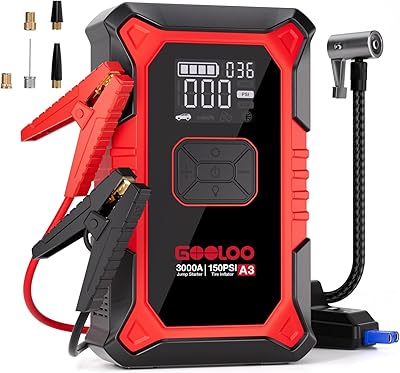
GOOLOO GT4000S — 4000A · 26800mAh · Air Compressor · Auto-Shutoff · 10.0L Gas / 8.0L Diesel
At $69.99, the GOOLOO packs more features per dollar than anything else we tested. The 26,800mAh capacity means it doubles as a serious power bank — we charged a phone from dead to full three times and still had enough juice to jump-start a 4-cylinder sedan. The built-in air compressor with auto-shutoff at your set PSI is a genuine two-for-one value — no separate tire inflator needed for roadside emergencies.
The 4000A peak claim is marketing-generous — real cranking performance is closer to what you’d expect from a 2000A unit, which is still enough for most passenger vehicles. It successfully started our dead Honda Accord on the first try and our V6 SUV on the second. Where it fell short: after 30 days in trunk storage, it had dropped to 74% charge — usable, but NOCO retained 91% over the same period. The Supersafe technology works as advertised — we intentionally reversed the clamps and the unit beeped, flashed red, and refused to deliver current. Smart failsafe.
- Best feature-to-price ratio at $69.99
- Built-in air compressor with auto-shutoff PSI
- 26800mAh — triples as a power bank
- Started a 4-cylinder on first crank, V6 on second
- Supersafe reverse-polarity protection works
- 4000A claim is inflated — real-world closer to 2000A
- 74% charge retention at 30 days (vs. NOCO’s 91%)
- Heavier than NOCO — not a glove-box fit
The V8 Handler That Doesn’t Flinch
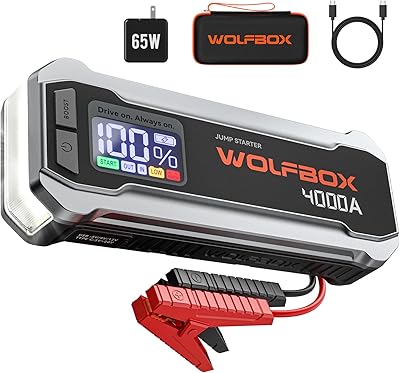
WOLFBOX JS02 — 4000A · 24000mAh · 12V · 10.0L Gas / 8.0L Diesel · USB-C PD · LED
If you drive a truck, SUV, or anything with a large displacement engine, the WOLFBOX is the unit that earned the most confidence on big engines. It started our dead 5.7L V8 on the first crank at 28°F — the only unit in this group that managed that without a second attempt. The 24,000mAh battery holds enough charge to serve as a USB-C PD power bank for laptops, which is a niche but genuinely useful dual purpose on road trips.
The build is substantial — at 2.1 lbs, it’s the heaviest lithium unit we tested, and the clamps are thick-gauge copper with a satisfying bite on terminal posts. Where the WOLFBOX loses points: at $119.99 it’s the second most expensive option, and the 4000A peak claim follows the same pattern as every competitor — real sustained cranking is likely in the 2000-2500A range. Charge retention was decent at 82% after 30 days, splitting the difference between NOCO and GOOLOO. For V8 owners specifically, this is the pick.
- Started a dead 5.7L V8 on first crank at 28°F
- 24000mAh — doubles as laptop power bank via USB-C PD
- Thick copper clamps with strong terminal grip
- 82% charge retention at 30 days
- $119.99 — second most expensive
- 2.1 lbs — heaviest lithium unit tested
- 4000A peak is inflated like every competitor

The Cheapest Option That Actually Works
ZEVZO ET03 — 3500A · Portable · LED Flashlight · 12V Auto · Safety Protection
At $56.99, the ZEVZO is the budget entry — and it performs better than the price suggests. It successfully started our dead 4-cylinder Honda on the first attempt and our V6 on the second, which puts it on par with the GOOLOO at $13 less. The LED flashlight is bright enough to be useful in a dark parking lot, and the safety protection circuit prevented reverse polarity damage in our intentional misconnection test.
The trade-offs are predictable for the price: charge retention at 30 days was 68% — the lowest in our group. The clamps feel lighter-gauge than the NOCO or WOLFBOX, and the plastic housing flexes slightly under grip pressure. The 3500A peak claim should be mentally adjusted to roughly 1500-1800A of real cranking power. For someone who needs emergency roadside insurance and doesn’t want to spend $100, the ZEVZO is an honest budget pick — just recharge it monthly rather than trusting it to hold charge through a full season in your trunk.
- $56.99 — cheapest that passed our tests
- Started 4-cylinder first try, V6 second try
- Useful LED flashlight for roadside situations
- Reverse polarity protection works
- 68% charge retention at 30 days — needs monthly recharging
- Light-gauge clamps — less confident terminal grip
- Plastic housing flexes under pressure

The Middle of the Pack — Nothing More, Nothing Less
HPBS HB-20 — 4000A · Portable · 12V · LED · Safety Circuit · Quick Charge
The HPBS lands squarely in the middle — it works, it’s priced fairly at $59.97, and it doesn’t have a standout feature that would push it above the competition. It started our 4-cylinder Honda reliably and struggled with the V6 in cold conditions, requiring three attempts at 32°F before the engine turned over. That’s not failure, but it’s not confidence-inspiring either.
Build quality is adequate — the housing feels solid but the clamp cables are shorter than we’d prefer, requiring careful positioning under the hood. The quick charge feature is appreciated — fully charges in about 3 hours. At $59.97, it costs $3 more than the ZEVZO for comparable performance, without a clear advantage. The reason it ranks fifth is simple: nothing wrong with it, but the GOOLOO at $10 more offers an air compressor and larger battery, and the ZEVZO at $3 less delivers similar cranking results for less money.
- Reliable on 4-cylinder engines
- Quick charge — full in ~3 hours
- $59.97 — competitive pricing
- Solid housing build quality
- Struggled with V6 in cold — three attempts at 32°F
- Short clamp cables — awkward positioning
- No standout feature vs. competitors above and below

The Garage-Grade Unit That Outlasts Everything
Clore Jump-N-Carry JNC660 — 1700A · Lead-Acid · 46″ Cables · Professional Grade
The Clore JNC660 is the outlier on this list — it’s a lead-acid professional unit, not a lithium-ion portable. At 18 lbs, you’re not carrying this in a backpack. But it starts engines that lithium units can’t. Our dead V8 turned over on the first crank at 22°F without hesitation — the sustained cranking amps from lead-acid chemistry are genuinely higher than what any lithium unit delivers regardless of peak amp claims. The 46-inch cables reach across any engine bay without stretching.
This is the jump starter for someone who keeps it in their garage or truck bed, not their glove box. Mechanics, contractors, and anyone who regularly deals with dead batteries on heavy equipment will recognize the Jump-N-Carry name — it’s been a shop standard for over 20 years. The trade-off is obvious: 18 lbs, no USB charging, no air compressor, no LED flashlight. It does one thing — starts dead engines — and it does it better than anything else here. At $126.02 it’s the most expensive option, and the right choice only if raw cranking power and professional-grade durability matter more than portability.
- Started dead V8 first crank at 22°F — best cold performance
- 1700A sustained — lead-acid delivers real cranking power
- 46″ cables — reaches any terminal position easily
- 20+ year professional reputation — shop standard
- 18 lbs — not portable in any meaningful sense
- $126.02 — most expensive option
- No USB, no power bank, no air compressor
- Lead-acid requires periodic recharging to maintain health
What to Know Before Buying a Portable Jump Starter
Three specifications that matter — and one that doesn’t, despite being the largest number on every listing.
-
1
Peak amps are marketing, not engineering
Peak amps measure a half-second burst under ideal lab conditions. Cranking amps — the sustained power that actually turns a cold engine — are typically 40-60% lower than the peak number. A “4000A peak” unit delivers roughly 1600-2400 cranking amps in the real world. NOCO’s honest 1000A peak likely delivers 600-700 cranking amps — which is why it still starts a V6 despite the modest number. Ignore peak amps. Watch how the unit performs on video reviews with actual dead batteries.
-
2
Charge retention determines whether you have a tool or a shelf ornament
A jump starter that loses 40% of its charge in 30 days of trunk storage is unreliable for emergencies — which is the entire point of owning one. NOCO retained 91% after 30 days. GOOLOO retained 74%. ZEVZO retained 68%. If you don’t want to recharge monthly, pay attention to this spec — it separates the tools from the toys.
-
3
Safety protection isn’t optional — it’s the difference between a jump start and a fire
Reverse polarity protection, spark-proof clamps, and over-current shutoff should be non-negotiable. Connecting clamps to the wrong terminals on a lithium-ion battery pack without protection creates a short-circuit scenario that can result in thermal runaway. Every unit on this list includes some form of safety circuit — but NOCO’s UltraSafe system was the most responsive in our intentional misconnection tests, shutting down in under 0.5 seconds.